
Choosing the Best Plywood and Lumber for Durable DIY Entryway Organization
Stop building entryway furniture that sags. Discover the expert guide to selecting the right plywood grades and hardwood species for mudrooms that last a lifetime.

Feb 18, 2026 - Written by: Linda Wise

I have stood in too many mudrooms where the “custom” built-ins look tired only six months after installation. You know the look: shelves bowing under the weight of textbooks, paint chipping off sharp corners, and drawer fronts that have swelled from wet boots. It’s heartbreaking because the homeowner usually spent weekends sweating over the project, only to be betrayed by their materials.
The reality of DIY woodworking is that your skill level often matters less than your material selection. You can execute perfect joinery, but if you cut those joints into low-grade particle board or wet construction lumber, the piece will fail. The entryway is not a bedroom; it is a high-traffic, high-moisture combat zone. It requires a completely different approach to material science than a bookshelf in a climate-controlled den.
We are going to dismantle the confusion surrounding lumber yards and big-box store aisles. We will look at exactly what you need to buy to build an organization system that doesn’t just survive the chaos of family life but actually thrives in it.
The Physics of the Entryway: Why Material Matters
Before we talk about grades of plywood, we have to acknowledge the enemy. Your entryway faces three distinct stressors that other furniture does not: dynamic loading, impact, and moisture cycling.
When someone sits on a bench to tie their shoes, that is dynamic loading. When a kid throws a lacrosse stick into a cubby, that is impact. When wet umbrellas drip onto a shelf, that is moisture cycling. Most generic “whitewood” from home centers is built for framing houses behind drywall, not for withstanding this trifecta of abuse.
If you are in the planning phase, you are likely already calculating the precise dimensions required to fit your space. However, those dimensions are useless if the material itself lacks the structural integrity to span those distances without sagging.
The Plywood Primacy: Understanding Cores and Veneers
For 90% of entryway projects—lockers, carcasses, and bench boxes—plywood is superior to solid wood. It is dimensionally stable, meaning it won’t expand and contract with humidity changes as drastically as solid boards. But “plywood” is a catch-all term that covers everything from garbage sheathing to furniture-grade masterpieces.
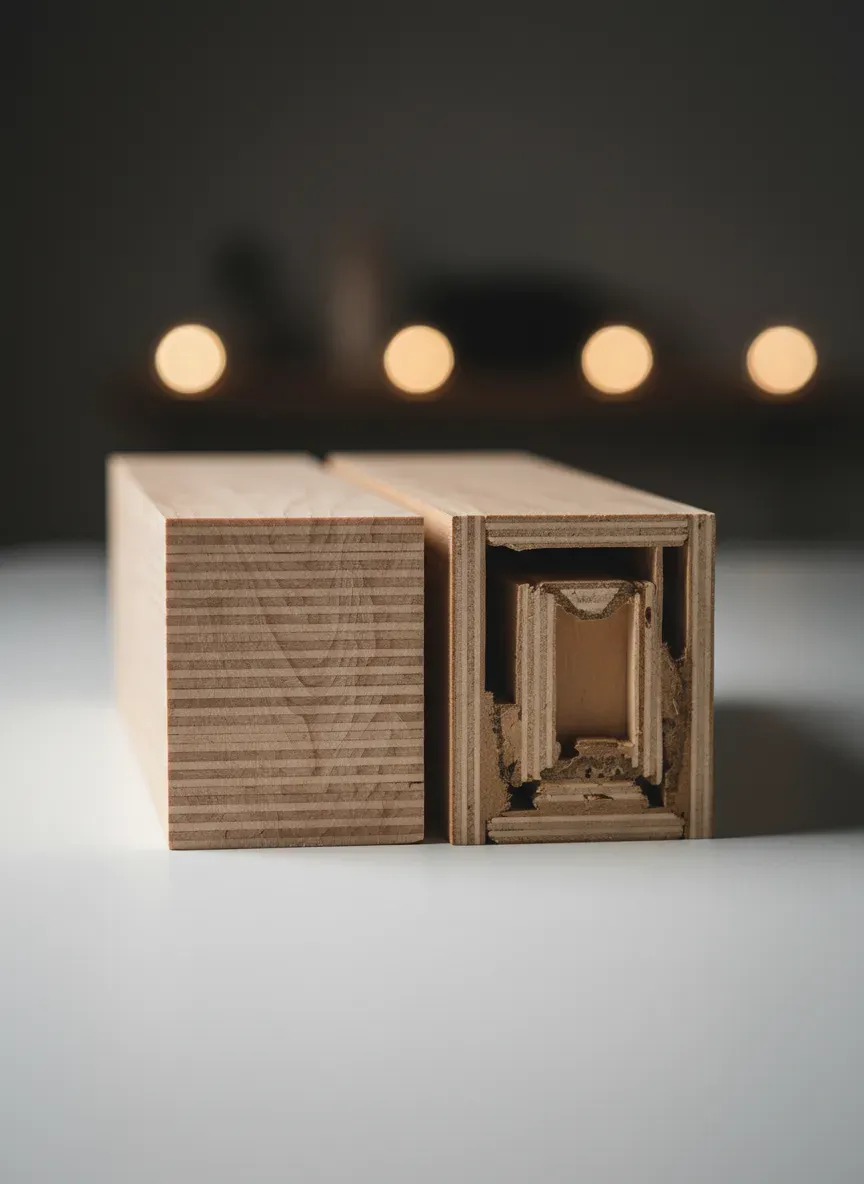
1. Baltic Birch (The Gold Standard)
If budget allows, Baltic Birch (often labeled as Russian Birch, though sourcing has shifted) is the undisputed king. Unlike standard plywood, which might have 5 or 7 layers (plies) for a 3/4-inch sheet, Baltic Birch usually has 13 layers of solid birch veneer.
- No Voids: Standard plywood has holes in the inner layers. If you cut into one, you get an ugly gap. Baltic Birch is solid all the way through, meaning you can leave the edges exposed for a modern look.
- Screw Holding: Because of those dense layers, screws bite hard and stay put. Hinges won’t wobble loose after a year.
2. Domestic Maple or Oak (Veneer Core)
This is what you will likely find at a decent lumber yard. It features a thin face veneer of a hardwood (like Maple) over a core of softer woods (like Fir or Poplar).
- The Trap: Avoid “MDF Core” plywood for entryways unless the unit is completely off the floor. MDF acts like a sponge. If a wet boot sits on an MDF-core shelf, it will swell and burst. Stick to “Veneer Core” (VC).
3. The “Big Box” Cabinet Grade
You will see sheets labeled “Cabinet Grade” at Lowe’s or Home Depot. I’ve used them, and they are serviceable, but you need to be wary. The face veneers are often paper-thin (1/40th of an inch). If you sand too aggressively, you will burn right through to the ugly core wood.
Pro Tip: When buying plywood, look at the edge of the stack. If the layers look like a jagged mountain range, walk away. You want straight, uniform lines.
Solid Lumber: Face Frames and Trim
While plywood builds the box, solid wood protects the edges. This is where you gain durability. You should never leave raw plywood edges exposed in a high-traffic zone (unless it’s high-grade Baltic Birch) because they will splinter. You need to apply a “face frame”—a solid wood border.
The Hardwood Hierarchy
When weighing natural timber against industrial metal frameworks, wood offers a warmth that metal lacks, provided you choose a species hard enough to take a beating.
Poplar: The Paint-Grade Workhorse
If you plan to paint your entryway organizer, Poplar is your best friend.
- Pros: It is relatively inexpensive, mills easily, and takes paint beautifully.
- Cons: It is technically a hardwood, but it’s soft. A fingernail can dent it. For vertical stiles (the upright parts of a face frame), it’s fine. for the seat edge? Maybe not.
Soft Maple: The Durability Sweet Spot
Do not let the name fool you. “Soft” Maple is significantly harder than Poplar and pine. It is the industry standard for painted cabinetry that needs to resist dings. It has a tight grain that doesn’t require filling, and it stands up to the impact of backpacks and shoes.
Red/White Oak: The Stain-Grade Choice
If you want the wood grain to show, Oak is the classic choice. It is incredibly hard and rot-resistant. White Oak, in particular, has closed tyloses in the pores, making it naturally water-resistant—perfect for that spot right near the door threshold.
The Construction Lumber Trap
I have seen countless DIY blogs recommend using 2x4s for entryway benches to save money. This is generally a mistake for fine furniture. Construction lumber (Pine/Fir) is:
- Wet: It often has 12-19% moisture content. As it dries in your house, it will twist and crack your paint.
- Soft: It dents if you look at it wrong.
- Resinous: Knots will bleed sap through your paint for years.
If you must use dimensional lumber for a rustic look, you need to let it acclimate inside your house for weeks before cutting. To verify it’s ready, I rely on the General Tools MMD4E Digital Moisture Meter. It saves you the heartache of building a bench that shrinks and pulls away from the wall a month later.
Structural Engineering for DIYers
You don’t need a physics degree, but you do need to understand sag. A 3/4-inch plywood shelf can only span about 30 to 36 inches before it starts to bow under significant weight.
If you are reclaiming dead space beneath stairwells or building wide lockers, you have to reinforce the shelves. You can do this by:
- The Nosing Trick: Glue a 1x2 solid wood strip to the front edge of the plywood shelf. This acts like an I-beam, stiffening the shelf significantly.
- The Rear Cleat: Support the back edge of the shelf against the wall studs.
Determining Bench Thickness
For the bench seat itself, a single sheet of 3/4-inch plywood feels flimsy. It lacks the visual weight and the physical rigidity we associate with quality.
The Solution: Laminate two pieces of 3/4-inch plywood together to create a 1.5-inch thick slab. Or, use solid 8/4 (2-inch thick) lumber. This provides the structural integrity required for seating and ensures that when an adult sits down to put on boots, the bench feels like a rock, not a trampoline.
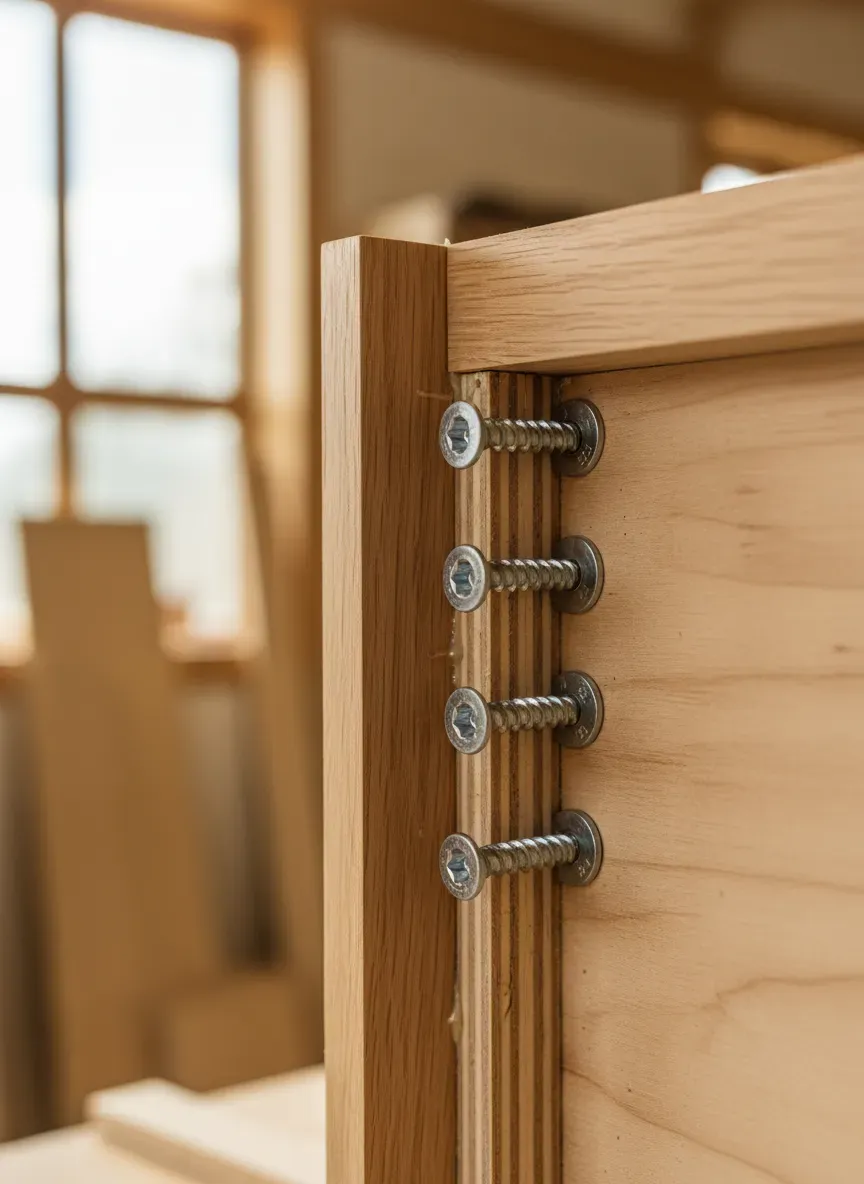
Joinery That Lasts
You have the right wood; now how do you stick it together? Nails alone are insufficient for an entryway. The dynamic loading will vibrate smooth nails loose over time.
Pocket Holes
For the DIYer, pocket joinery is the bridge between amateur and pro results. It allows you to create strong, mechanical connections without needing complex clamps. However, you must use the coarse-thread screws for softwoods/plywood and fine-thread for hardwoods (like Maple/Oak).
If you want the best experience, I highly recommend checking out the Kreg Pocket-Hole Jig 720PRO. It clamps automatically and speeds up the carcass construction massively compared to older models.
Dados and Rabbets
If you have a table saw or router, cutting a dado (a groove) for the shelves to sit inside the vertical panels provides immense strength. The wood itself bears the load, not just the screw.
Finishing: The Invisible Armor
You could buy $500 worth of Walnut, but if you finish it with a cheap wax, it will be ruined in a week. Entryways need film-building finishes or high-performance oils.
- Water-Based Polyurethane: This is the go-to for painted projects or light woods like Maple. It doesn’t yellow over time. Look for “High Traffic” or “Floor” rated formulas. If it can handle foot traffic, it can handle a backpack.
- Hardwax Oils (Rubio Monocoat/Osmo): These are fantastic for natural wood benches. They bond with the wood fibers rather than sitting on top. The benefit? If you get a scratch, you can spot-sand and re-apply oil without stripping the whole piece.
- Avoid: Standard Shellac or Nitrocellulose Lacquer. They are too brittle and sensitive to water (and alcohol).
When creating abuse-resistant zones for little ones, consider that the finish needs to be scrubbable. A semi-gloss or satin sheen is much easier to wipe mud off than a flat/matte finish.
Sourcing Strategy: Where to Buy
This is where projects often go off the rails.
The Home Center Run:
- Buy: Screws, glue, sandpaper, and maybe Poplar for paint-grade trim.
- Avoid: Their “Oak” boards (usually overpriced and warped) and their standard plywood for visible areas.
The Lumber Yard:
- This can be intimidating, but it’s worth it. You will buy lumber by the “board foot” (volume) rather than linear foot.
- Ask for “S3S” (Surfaced on 3 Sides) if you don’t have a planer and jointer. This means the board is flat and has one straight edge.
- The Potato Chip Test: Lay a board on the concrete floor. If it rocks, twists, or bows significantly, put it back. You cannot clamp the twist out of a board; it will fight you forever.
Specific Project Scenarios
Let’s break this down by the type of organizer you are building.
Scenario A: The Mudroom Locker System
- Carcass: 3/4” Pre-finished Maple Plywood. The clear coat is already applied at the factory, saving you hours of finishing the inside of cabinets.
- Face Frame: 1x2 Soft Maple. Paintable, hard, durable.
- Bench Top: 1.5” thick White Oak (solid planks joined together), finished with a matte floor polyurethane.
Scenario B: The Floating Entry Shelf
- Structure: Torsion box design using 1/2” Baltic Birch skins over a solid Poplar grid.
- Why: This creates a lightweight but incredibly stiff shelf that won’t sag over time. Solid wood is too heavy for deep floating shelves.
Scenario C: The Shoe Rack
- Shelves: Slatted wood rather than solid plywood.
- Why: Airflow. Wet shoes need to dry. Using 1x2 slats of Cedar or White Oak prevents mold growth and allows dirt to fall through to the floor for sweeping, rather than accumulating in corners.
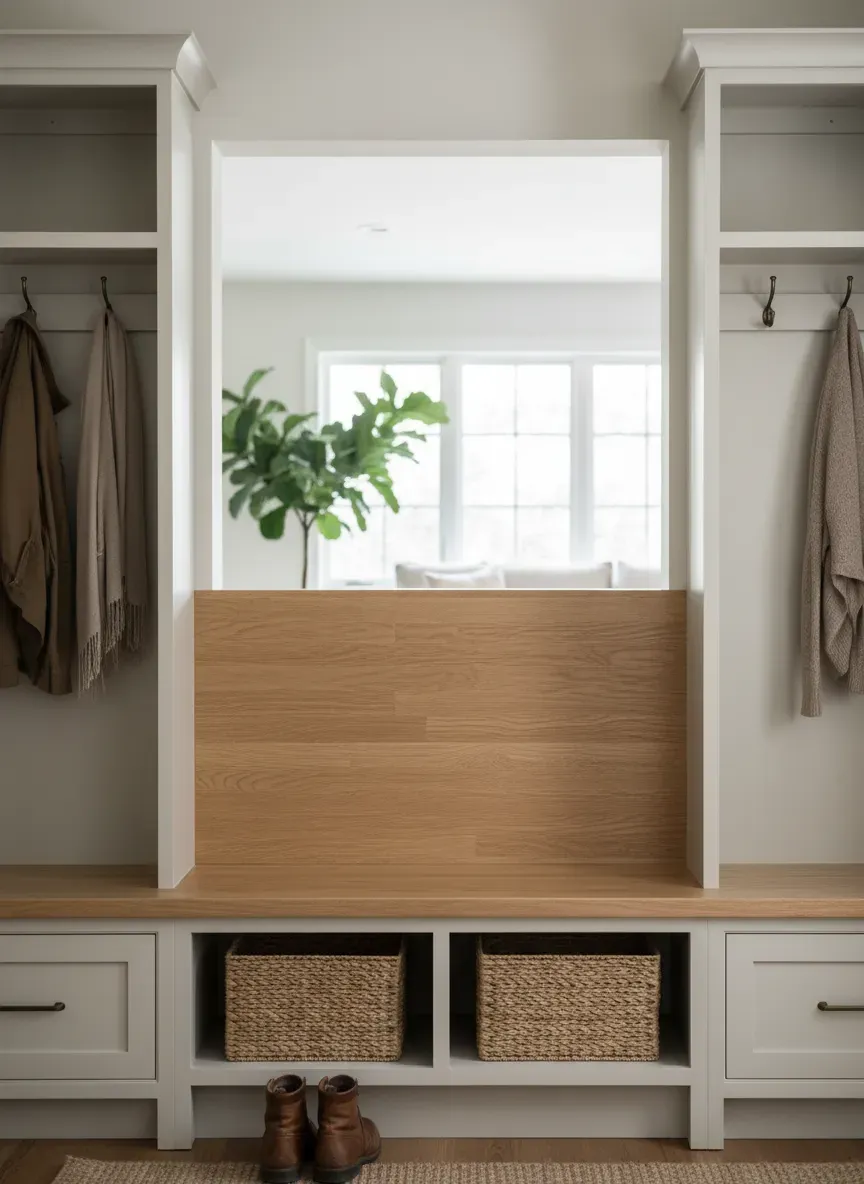
Essential Tooling for Plywood
Cutting plywood requires finesse. The factory edge is perfect; your saw cut needs to match it. A standard 24-tooth framing blade will chew up the veneer, leaving splintered edges that look unprofessional.
You need a high-tooth count blade. The Diablo 7-1/4 in. 60-Tooth Fine Finish Saw Blade is essential if you are using a circular saw. It slices through veneer cleanly, minimizing tear-out and saving you hours of sanding and puttying later.
Key Takeaways
- Core Matters: Avoid MDF core plywood for any surface that touches the floor. Stick to Veneer Core or Baltic Birch.
- Thickness Rules: Use 3/4” (19mm) plywood for structure. Use 1/4” only for cabinet backs.
- Hardness: For painted face frames, Soft Maple beats Poplar for dent resistance.
- Acclimation: Bring solid lumber into your home for at least 7 days before cutting to prevent warping.
- Span Limits: Do not span 3/4” plywood more than 36 inches without reinforcement.
The Bottom Line
Building entryway organization is an investment in your home’s functionality. While it is tempting to save $100 by choosing lower-grade sheeting or construction lumber, the labor cost (your time) remains the same. The difference is that the higher-quality material yields a result that adds value to your home and withstands the daily assault of backpacks and boots.
Buy the good wood. Cry once at the register, rather than every time you look at a sagging shelf.