

The Complete Guide to Entryway Benches with Storage
One spot to sit. Every pair of shoes with a home. Everything you need to pick the right storage bench — and never buy another that splinters.
An entryway bench with storage is the highest-function piece of furniture your entryway can have: one spot to sit, and every pair of shoes has a home. That's it — that's the whole pitch. No bench does more work for your household per square foot, and no bench is more commonly bought wrong.
I've organized, assembled, and lived with entryway benches for a long time, and I've seen the same four mistakes over and over: buying a bench too deep for the hallway, buying one that doesn't fit the tallest boot in the house, buying a basket bench when what they needed was a lift-top, and — the classic — buying whichever bench was on sale and watching the drawers sag 18 months later.
This guide is the version I wish I'd had before the first purchase: what storage types actually do, the best entryway storage benches at the budgets that matter, what holds up for big families, and the three measurements that prevent 90% of buyer's remorse. No marketing-speak. Nobody wants to hear "elevate your entryway" — we want a bench that doesn't split when a 200-pound dad sits on it.
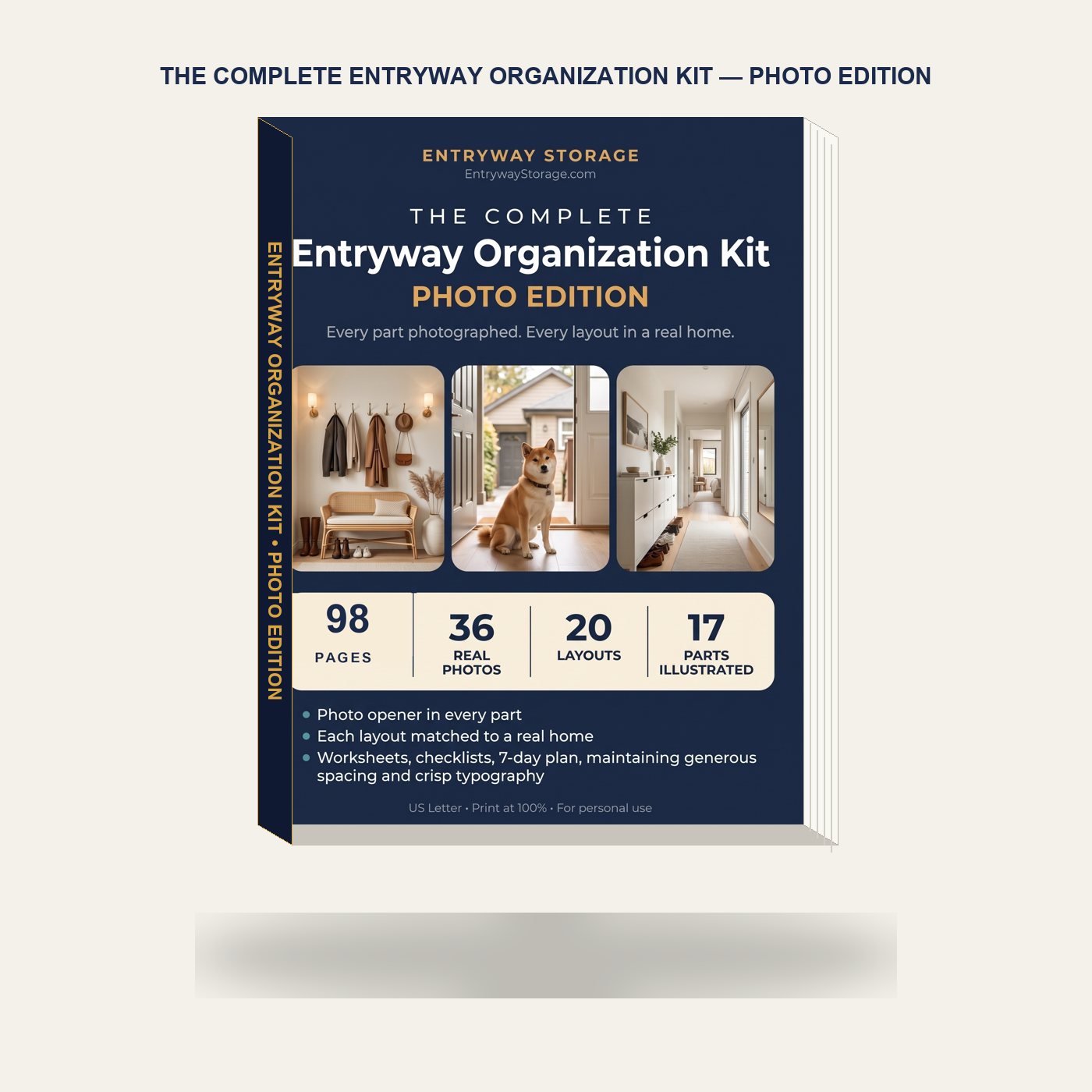
Planning an Entryway Bench Makeover?
Get 20 facing photo spreads with exact bench clearances, CAD wall elevations, and printable worksheets — from $17.99.
Get The Photo Edition Kit ($17.99 – $39.99) →Why Storage Benches Beat Plain Benches
A plain bench gives you a place to sit. A storage bench gives you a place to sit and removes the thing your entryway is most cluttered with. Every pair of shoes that lives off the floor in a cubby is a pair that isn't being tripped over, isn't getting damp on the doormat, and isn't your morning decision.
The honest math: a typical household keeps 4–8 pairs of daily shoes by the door. A bench with open cubbies holds that plus backpacks. A bench with a lift-top holds bulky off-season gear. A bench with drawers hides the small stuff — gloves, dog leashes, chargers — that otherwise lives on the hall table. One footprint, three jobs.
There's a second, quieter reason, and it's the one that keeps people happy long-term: a storage bench changes behavior without asking anyone to change. You don't need a "drop-zone system." You need a surface that catches the drop. That's what the bench does.
Before you buy, the two things worth reading: our breakdown of the exact dimensions that fit real hallways, and drawers vs. cubbies when you can't decide.
Storage Types, Explained (lift-up, cubby, drawer, basket)
Almost every "storage bench" on the market is one of four types. Knowing which one you need is knowing which mess you're solving.
Cubby / open shelf benches
The bench has open openings under the seat, sometimes with shelf dividers. Shoes go in, shoes come out, no doors, no effort. Great for kids and daily footwear, terrible at hiding anything — a guest sees exactly how many sneakers you own.
Drawer benches
Sliding drawers (or baskets on rails) under the seat. Best for small, organized items — gloves, hats, dog gear, chargers. Requires the "put it in the right drawer" habit, and cheap drawer slides are the first thing to fail. Look for full-extension metal slides rated 75+ lbs.
Lift-top / flip-top benches
The entire seat lifts on gas pistons or hinges to reveal one massive cavity. Homerun for bulky stuff: off-season coats, sports equipment, blankets. The trade-off is ergonomics — you can't sit with the lid open, so it's a "park it, close it" system. See our lift-top deep-dive.
Basket benches
A wood bench with woven or fabric baskets tucked under. The most flexible and cheapest type: baskets come out, things get dumped in, and the look is warm. The catch is that baskets hold their shape only as well as their frames — cheap ones sag into sad puddles within a year.
Most families end up happiest with a mix: open cubbies for shoes (the daily volume), plus one drawer or basket for the small stuff. That combination covers 90% of entryway chaos. If you need the reasoning spelled out in more depth, the open vs. closed storage question has the full argument.
Best Entryway Storage Benches Under $200
Under $200 is a crowded, mostly crappy market — but there are real winners. What makes a sub-$200 bench worth your money:
- Solid (or genuinely heavy) construction: real wood legs or a full steel frame. No bench under $200 is made of solid hardwood throughout; the winners use solid wood on the parts that take the load (legs, seat rails) and engineered wood elsewhere.
- Weight capacity stated in writing: hunt for benches rated 250–350 lbs. Under $200, anything rated under 200 lbs is a kids-only bench wearing adult clothes.
- Drawers with metal slides: skip anything with wood-on-wood drawer tracks.
- Assembled weight above ~35 lbs: suspiciously light benches are particleboard with the frame weight doing all the work.
Our affordable entryway benches under $150 roundup ranks the specific models we've verified — the same units are the backbone of the best entryway storage benches for every budget list at the lower end.
Best Storage Benches for Big Families
Big families don't need a bigger bench — they need a bench built to take repeated abuse plus enough storage that the pile doesn't respawn overnight. Four things matter more than anything else:
- Seat rated 300 lbs or more. A 200-lb dad sitting down hard applies nearly double that as a dynamic load. If the seat is rated for 300+ lbs statically, it survives that. If it's rated 200, it won't for long.
- Indestructible kid surfaces: either painted solid wood that can be repainted, or a laminate that wipes clean. Fabric baskets under a bench with kids = laundry-smell storage. Choose ones that can be pulled and washed.
- Deep shoe storage, literally: families run through boots, cleats, and school shoes. Benches with two stacked cubby rows (shoes top, boots bottom) or a 16+ inch-deep cubby hold a family's worth. Maximizing capacity inside entryway benches is the guide for this exact problem.
- Rounded corners or protected edges. Every family's youngest child will find the sharp corner eventually. It's physics.
Models that pass the family test are covered in the family-focused bench guide, and if bench height matters to your crew (it does — kids and grandparents both need to get up from it comfortably), start from the standard mudroom bench height explainer.
How to Measure for a Storage Bench
Ten minutes with a tape measure prevents $300 of regret. Here's the exact routine:
- The hallway gap: measure the clear width of your entry path, then subtract 36 inches for walking room. Whatever's left is your maximum bench width. A 42-inch hallway, for example, allows a 6-inch bench — which means you need a compact or wall-mounted solution instead.
- The depth: measure from the wall to the edge of the door swing. If the bench sits against the swing wall, keep depth under 14 inches. 12–15 inches is the target for most entryways; only go 16–18 inches deep if you have genuine room.
- The tallest boot: line up the tallest footwear in the house (winter boots are usually the winners) and measure its height. That's your minimum cubby opening height — for most families, 7–8 inches works; for boot families, 10+ inches or a boot tray underneath instead.
- Seat height: look for 17–19 inches to the seat, and remember a cushion counts toward that height.
Full dimension-by-dimension thinking lives in the sizing secrets guide, and if your entryway is genuinely tiny, small-space entryway storage strategies will change what you even look at.
The Comparison Table
The short version, at a glance — price, storage style, and what each type is honestly good at:
| Bench Type | Typical Price | Storage Style | Weight Capacity | Seat Height | Best For |
|---|---|---|---|---|---|
| Open cubby / shelf | $120–$400 | Cubbies under seat | 250–350 lbs | 17–19 in | Daily shoes, kids, quick drop-and-go |
| Drawer bench | $150–$500 | 1–3 drawers | 250–350 lbs | 17–19 in | Gloves, hats, small organized items |
| Basket bench | $100–$350 | Woven/fabric baskets | 200–300 lbs | 17–19 in | Flexible dump storage on a budget |
| Lift-top / flip-top | $180–$650 | One large hidden cavity | 300+ lbs | 17–19 in | Bulky gear, off-season items, zero visible clutter |
| Bench with coat rack (hall tree) | $200–$700 | Cubbies + drawers + hooks | 250–400 lbs | 17–19 in | Complete entryway systems in one footprint |
The last row is the vertical cousin of the storage bench — if you have the wall space, benches with integrated coat hooks are the single most useful entryway piece most families can buy.
The Fine Print
Every bench type above has a version that's excellent and a version that's particleboard with a dream. The difference is almost always in the parts you can't see from the product photo: the drawer slides, the seat rail joinery, the frame gauge, and the rated weight capacity. Buy on weight rating and drawer hardware first, style second.
And if you're handy, the DIY route gets you a bench as strong as anything in a store for a third of the price — building your own entryway bench with storage is a genuinely achievable weekend project with a circular saw and a pocket hole jig.
The rest of this site is organized around the same problem. Start with our ranking of the best storage benches for every budget, visit the smart shoe storage guide for the shoe half of the equation, or go straight to vertical storage if your floor space is the problem, not the bench.
More from This Guide
The 15 Best Entryway Benches with Storage
Our continuously updated list of the models we'd actually buy, across every budget and style.
Top-Rated Entryway Benches of 2026
The 2026 standouts ranked by verified reviews, capacity, and construction quality.
Child-Proofing Entryway Benches
Anti-tip straps, soft-close hinges, and rounded corners — the safety pass every family needs.
Keeping Storage Benches Clean Year-Round
The daily reset and material-specific cleaning that keeps a bench looking new.
Frequently Asked Questions About Entryway Benches with Storage
What is the best type of storage bench for an entryway?
For most households, a bench with open cubbies under the seat is the best everyday pick: shoes drop in and out with zero friction, nothing needs to be opened, and kids actually use it. Add one drawer or basket for small items (gloves, leashes, chargers) and you've covered nearly every entryway pile. Choose a lift-top instead if your clutter is big and bulky — sports gear, off-season coats — rather than daily shoes.
How much weight should an entryway storage bench hold?
Look for a seat rated for 300+ pounds if adults will sit on it regularly. Sitting down hard applies nearly double your body weight as a dynamic load, so a 200-lb adult needs more than a 200-lb bench. If the product page doesn't state a weight capacity, the bench is probably not built for adults — move on.
What is the ideal height and depth for an entryway storage bench?
Seat height should be 17–19 inches from the floor (cushions count toward that), and depth should be 12–15 inches for most entryways, up to 18 inches if you have real room. In a typical hallway, leave at least 36 inches of walking clearance in front of the bench.
Are entryway storage benches with drawers or cubbies better?
Cubbies are better for daily shoes and kids — they require zero effort and air out damp footwear. Drawers are better for hiding small, cluttery items like gloves, keys, and dog gear, and they keep the entryway looking tidy. The best compromise is a bench with open cubbies for shoes plus a single drawer or basket above or beside them.
Can I build an entryway storage bench myself?
Yes. A basic cubby bench is one of the friendliest beginner woodworking projects: a 3/4-inch plywood box with a front frame, a solid wood seat, and a toe kick. With a circular saw, drill, and pocket-hole jig, a first-time builder can finish one in a weekend for $100–$200 in materials — stronger than most comparably priced store benches.
How do I keep a storage bench from tipping over?
Anchor it. Any furniture taller than it is deep — including bench-and-coat-rack combos — should be secured to a wall stud with an anti-tip strap or bracket. On hard floors, add rubber pads under the legs so the bench doesn't slide when someone sits down hard. This matters doubly in homes with young kids.
