
Hall Tree With Drawers: Dimensions, Drawer Depth & Hardware Guide
Architectural dimensions and clearance guide for hall trees with drawers: 36 to 60 inch entryways, door swing math, drawer extension clearance & bench weight limits.
Aug 29, 2026 · Linda Wise
33 min readLast Updated: 2026-08-29 | Reviewed by: Managing Editor Linda Wise Compiled from manufacturer specifications and commonly reported buyer-review failure modes — not hands-on lab testing. Verify dimensions and weight ratings on the retailer page before buying.
An entryway is a high-traffic choke point. Choosing the wrong hall tree with drawers blocks your front door, pinches walkways, or leaves you with sagging drawers after one winter. Most design guides gloss over the physical realities of spatial clearances, drawer slide load-ratings, and wall-anchor mechanics for a hall tree with drawers.
This guide is different. We approach the hall tree with drawers from a strict structural perspective. Below, you will find the room layout mathematics, ergonomic calculations, and structural specifications required to select the best hall tree with drawers for your specific architectural footprint.
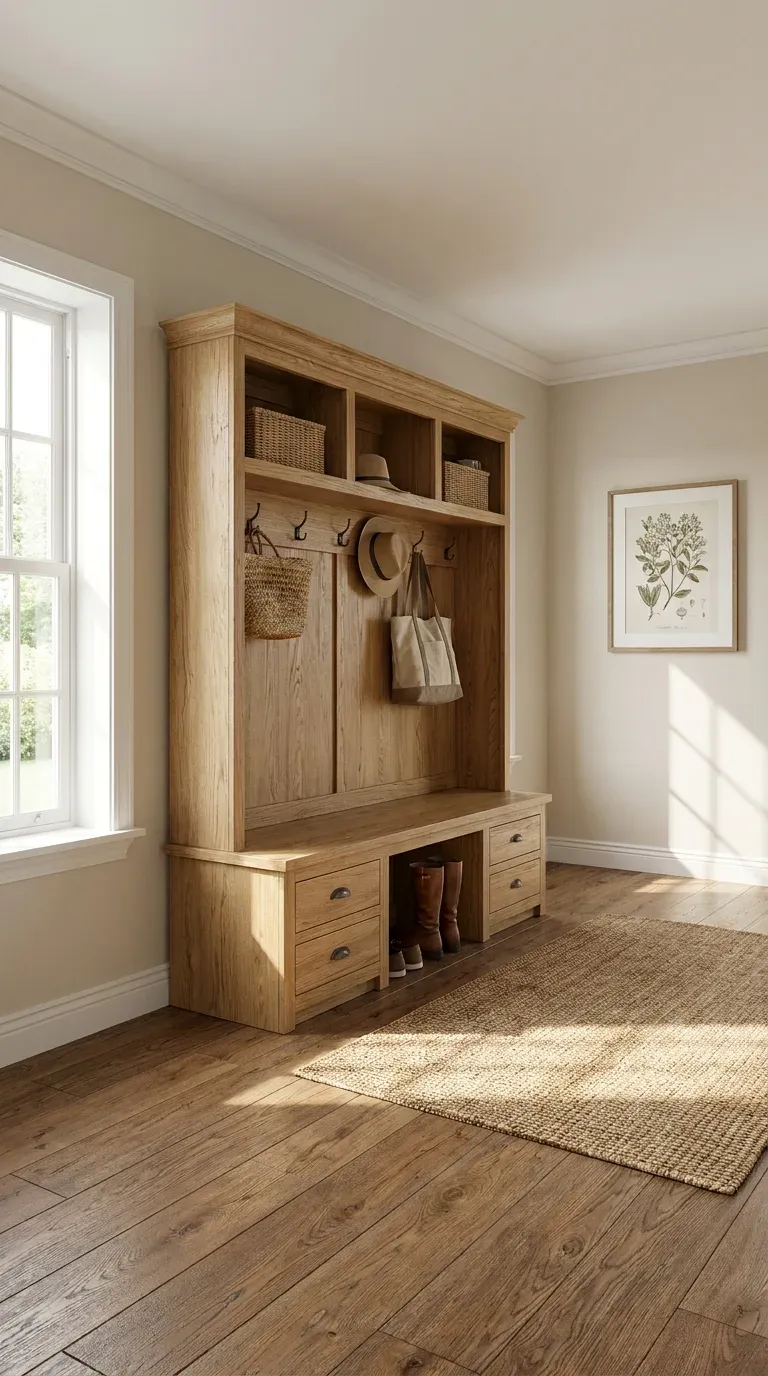
Hall Tree with Drawers Spatial Clearance & Traffic Flow Mathematics
To prevent your entryway from turning into an impassable obstacle course, you must design with physical clearances in mind. The primary mistake homeowners make is choosing a hall tree that physically fits the wall space but fails to account for human movement.
+-------------------------------------------------------------+
| WALL BOUNDARY |
+-------------------------------------------------------------+
| |
| +---------------------------------------+ |
| | HALL TREE | |
| | (Depth: 15" to 18") | |
| +---------------------------------------+ |
| | |
| | Drawer Slide Extension |
| | (Typically 12" to 14") |
| v |
| ========================================= |
| | EXTENDED DRAWER ZONE | |
| ========================================= |
| | |
| | Human Ergonomic Squat Zone |
| | (Minimum 18") |
| v |
|......................................... |
| | ACTIVE USER FOOTPRINT | |
|......................................... |
| | |
| | Remaining Clear Walkway |
| | (Absolute Minimum 36") |
| v |
+-------------------------------------------------------------+
| OPPOSITE WALL |
+-------------------------------------------------------------+
The Golden Rule of Hallway Walkways
The International Residential Code (IRC) dictates a minimum hallway width of 36 inches. If your entryway hallway is exactly 36 inches wide, a wall-anchored hall tree is highly discouraged unless installed in an adjacent recessed alcove. For typical residential use, a 42-inch clear pathway is the standard for comfortable single-person passage. A 60-inch pathway is required for two adults to pass each other without turning sideways.
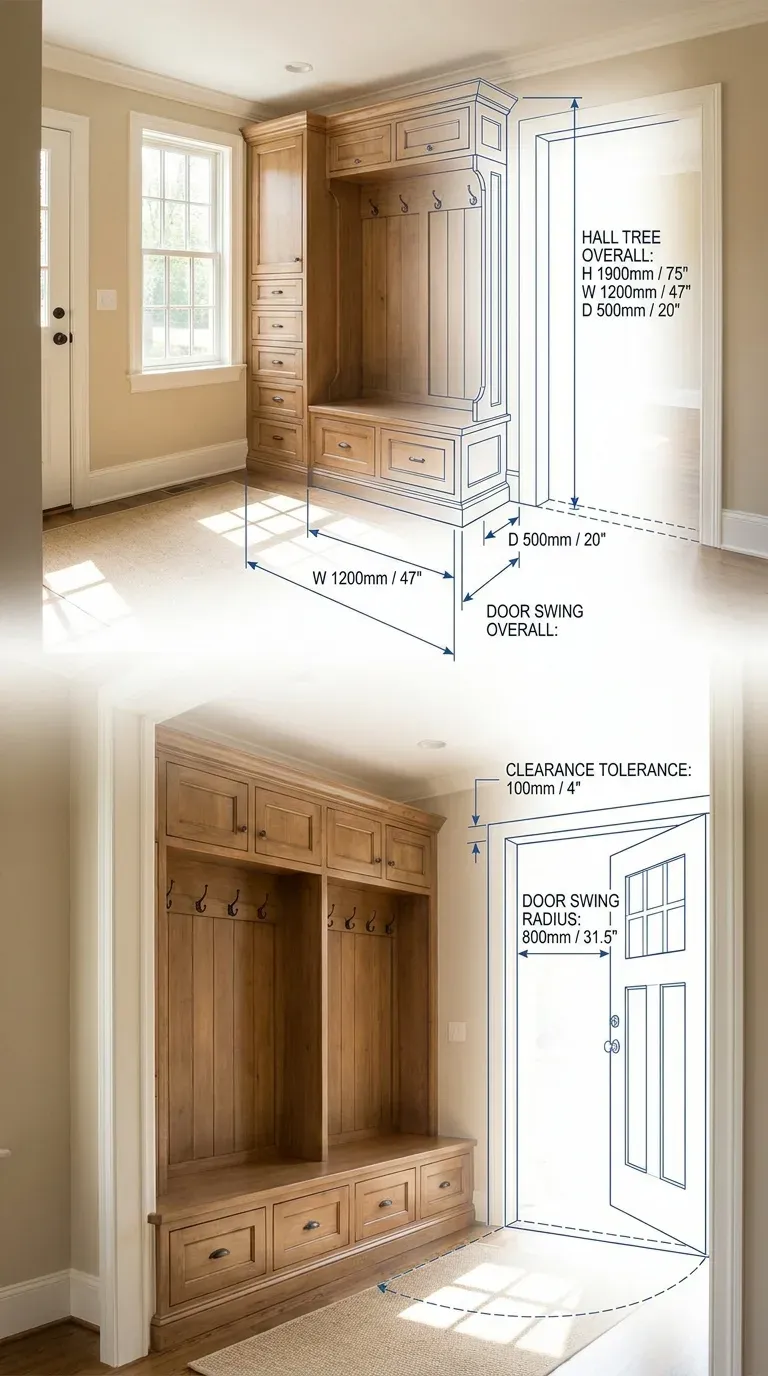
The Door Swing Radius Calculation
If your front door swings inward toward your hall tree, you must calculate the sweep arc:
If you have a 36-inch entry door, do not place a hall tree within a 39-inch radius of the hinge pivot point. If the door swing strikes the hall tree, you will damage both the wood finish of the organizer and the door handle hardware.
Drawer Extension & Squat Clearance
A drawer does not merely occupy its closed footprint. It operates in dynamic space:
- Average Bench Depth: $15\text{ to }18\text{ inches}$.
- Average Drawer Slide Extension: $12\text{ to }14\text{ inches}$.
- Human Body Depth (Squatting/Bending to open): $18\text{ to }22\text{ inches}$.
To pull open a bottom drawer and comfortably retrieve a pair of shoes, you require a total clearance depth of at least 45 to 54 inches from the back wall. If the opposite wall or a piece of furniture is closer than 45 inches, you will be forced to stand awkwardly to the side, increasing the risk of spine rotation under a load.
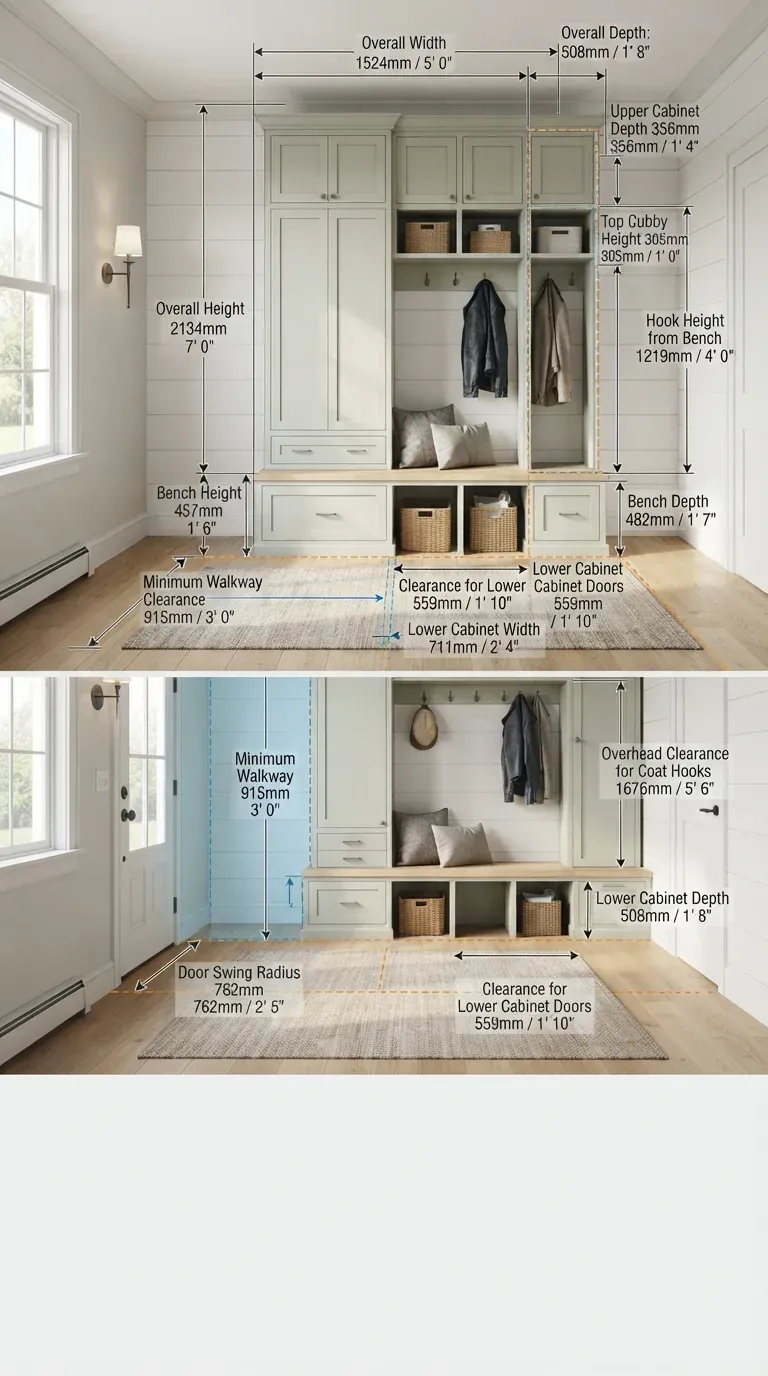
Hall Tree with Drawers Ergonomic Height & Depth Blueprint
A well-designed hall tree must accommodate the physical proportions of the human body. These ergonomic markers should guide your evaluation of different manufacturers.
Bench Seating Height (17” - 19”)
The standard dining chair seat height is 18 inches. A hall tree bench should stay strictly within the 17 to 19-inch window. Anything lower than 17 inches causes excessive knee flexion, which is uncomfortable for elderly users or anyone with joint issues. Anything higher than 19 inches leaves your feet dangling, making it difficult to tie shoes securely.
The Hook Reach Envelope (54” - 72”)
Hooks must be accessible to multiple age groups and heights:
- Standard Adult Reach: Dual-tier hooks should be positioned at 64 to 72 inches from the floor. This prevents long overcoats from draping onto the bench platform.
- Accessibility / Child Reach: Lower secondary hooks must be placed between 36 and 48 inches. This teaches children to hang their own gear and prevents them from climbing on the bench to reach high pegs.
Upper Cubby Clearances
If your chosen unit features upper cubbies, their lower lip must clear an average adult’s seated head height. When sitting on an 18-inch bench, your head height ranges from 50 to 56 inches from the floor. Ensure any overhanging shelving units are either recessed by at least 4 inches relative to the bench front edge, or sit at least 58 inches high to prevent painful head bumps upon standing.
Hall Tree with Drawers: Tight Hallway vs. Large Mudroom Layout
Not all entryways are created equal. Let us audit how hall trees behave in divergent architectural layouts.
The Narrow, High-Traffic Corridor
- The Problem: Long, narrow hallways (48 inches wide or less) that feed directly from the front door to the living space.
- The Strategy: Minimize horizontal depth. Choose a hall tree with a maximum depth of 14 to 15 inches. Opt for integrated fabric drawers or flush-front wooden drawers with recessed pull rings rather than protruding metal handles. Protruding hardware will catch on coat pockets and purses as people walk past.
- Lighting Considerations: Tight hallways often lack windows. A dark, bulky hall tree will make the space feel like a cavern. Consider reading how to brighten your entryway using appropriate placement, mirrors, and light wood finishes.
The Open-Concept Foyer
- The Problem: No defined entry walls; the door opens directly into an expansive living or dining area.
- The Strategy: Use a wide hall tree (40 to 60 inches wide) to act as a faux architectural divider. A heavy, double-drawer unit with beadboard backing acts as a freestanding partition wall, carving out a designated zone. It defines the flow of foot traffic and prevents outdoor dirt from migrating into the living zone.
The High-Capacity Mudroom
- The Problem: A dedicated, high-moisture room exposed to wet boots, dripping raincoats, and heavy athletic gear.
- The Strategy: Prioritize materials that resist moisture-induced expansion. Standard MDF will swell and disintegrate in high-humidity mudrooms. Look for units built with powder-coated steel frames and solid wood or high-pressure laminate (HPL) surfaces. If you have the space, you might compare these units with dedicated mudroom lockers or larger standalone modular hall trees to maximize raw storage.
Hall Tree with Drawers: 10 Popular Models Compared by Specs
We compared the specification sheets of ten popular models — dimensions, drawer glide systems, and manufacturer weight ratings — so you can match a unit to your space. Specs below are spec-based, not hands-on test results; verify current specs and prices on the retailer page before buying.
1. VASAGLE Industrial Hall Tree with Drawer and Shoe Bench
This unit is designed specifically for tight spatial footprints, blending a structural steel frame with retro-toned composite wood surfaces.
- Height: 72.0” | Width: 27.6” | Depth: 12.6”
- Seat Height: 18.3”
- Drawer Type: 1x Large Removable Non-Woven Fabric Drawer with rigid cardboard structure and veneer front panel faceplate.
- Hardware Grade: 1.5mm powder-coated square iron tubing frame.
- Max Bench Weight Capacity: 220 lbs.
Pros:
- Ultra-shallow 12.6-inch depth is perfect for tight, 36-inch wide hallways.
- Fabric drawer construction reduces overall dead weight, making the unit easy to position.
- Includes dual anti-tip strap kits to prevent tipping.
Cons:
- The drawer slide has no metal ball-bearing tracks; it simply slides along the metal shelf surface.
- The fabric box bottom will bow if loaded with heavy metal tools or wet gear.
Spatial Best-Use Case:
Excellent for tight entryways where every millimeter of walkway width counts.
2. Homestyles Seaside White Hall Tree with Storage Drawers
A heavy-duty, classic cottage-style wooden hall tree designed to anchor a formal entryway.
- Height: 75.5” | Width: 40.0” | Depth: 18.5”
- Seat Height: 18.0”
- Drawer Type: 2x Solid wood core drawers on full-extension ball-bearing metal side glides.
- Hardware Grade: Heavy-gauge steel cabinet tracks, brushed nickel cup pulls.
- Max Bench Weight Capacity: 250 lbs.
Pros:
- Top-tier drawer hardware: The ball-bearing glides operate smoothly even when the drawers are packed to their 35 lb weight limit.
- Solid poplar wood and engineered wood frame provide excellent stability.
- Full beadboard back panel adds authentic architectural detail.
Cons:
- Large 18.5-inch depth requires a wide foyer. Do not place this in a narrow corridor.
- Assembly takes 2-3 hours and requires two people due to the weight of the components.
Spatial Best-Use Case:
Perfect for wide, open-concept foyers that need a high-quality furniture piece to anchor the space.
3. Crosley Furniture Seaside Hall Tree
A sibling to the Homestyles unit, this model focuses on a slightly more compact footprint while maintaining deep-set storage and traditional aesthetics.
- Height: 74.5” | Width: 38.0” | Depth: 18.0”
- Seat Height: 18.0”
- Drawer Type: 2x Deep-set pull-out drawers on heavy-duty metal glides.
- Hardware Grade: Solid brass coat hooks, anti-rust painted steel glides.
- Max Bench Weight Capacity: 250 lbs.
Pros:
- High-grade satin finish paint resists water rings from wet coats.
- Dowel-reinforced joints keep the frame sturdy, preventing the side walls from wobbling.
- Drawers are deep enough to hold adult boots horizontally.
Cons:
- The hooks are placed quite high, making them difficult for young children to reach.
- The high paint finish is susceptible to chipping if struck by metal belt buckles or pet leashes.
Spatial Best-Use Case:
Traditional homes with moderate-width foyers that need dedicated shoe containment.
4. Bush Furniture Salinas Hall Tree with Shoe Storage Bench and Drawers
This farmhouse-inspired unit prioritizes structural integrity, featuring thick side paneling and modern safety features.
- Height: 68.0” | Width: 32.0” | Depth: 16.0”
- Seat Height: 18.0”
- Drawer Type: 1x Double-width drop-down drawer or dual slide-out configurations (depending on specific model variant).
- Hardware Grade: Euro-style concealed hinges and soft-close drawer glides.
- Max Bench Weight Capacity: 250 lbs.
Pros:
- Salinas styling features tapered legs and curved base rails for an elegant look.
- The soft-close drawer mechanism prevents finger pinches, a crucial safety feature for families.
- Thick laminate finish shrugs off moisture from wet clothing.
Cons:
- Engineered wood construction makes the unit very heavy (nearly 90 lbs out of the box).
- Lower hook heights limit the length of overcoats you can hang without them pooling on the bench.
Spatial Best-Use Case:
Active family homes with children who need accessible, pinch-free shoe storage.
5. Harper & Bright Designs Wood Hall Tree with 3 Drawers
A massive, high-capacity unit that trades steel frames for a classic, heavy-set solid wood footprint.
- Height: 70.8” | Width: 40.3” | Depth: 18.5”
- Seat Height: 18.0”
- Drawer Type: 3x Individual pull-out drawers with wooden tracks and safety stop blocks.
- Hardware Grade: Solid brass hooks, heavy iron handles.
- Max Bench Weight Capacity: 275 lbs.
Pros:
- Three distinct drawer compartments allow you to easily organize gear by family member.
- Solid pine wood legs and frame offer superior load capacity.
- Deep bench platform provides plenty of room to sit down.
Cons:
- Wood-on-wood drawer tracks can stick in high-humidity summer months as the wood expands.
- Requires periodic application of wood wax to keep the drawer glides operating smoothly.
Spatial Best-Use Case:
Large mudrooms or country estates with plenty of room to spare.
6. Tribesigns 5-in-1 Entryway Hall Tree with Drawers
An industrial-style organizer designed to maximize vertical space and hang lots of coats.
- Height: 72.0” | Width: 39.3” | Depth: 15.7”
- Seat Height: 18.5”
- Drawer Type: 2x Push-to-open non-woven fabric drawers with vintage wood-grain faces.
- Hardware Grade: 0.9-inch thick metal framing, dual hanging rails.
- Max Bench Weight Capacity: 300 lbs.
Pros:
- Includes two hanging rails in addition to standard pegs, allowing you to hang coats on hangers.
- Impressive 300 lb weight limit on the bench.
- Adjustable feet compensate for uneven entryway floors.
Cons:
- The fabric drawers will sag if overloaded with heavy boots. Keep them for lightweight items like gloves, scarves, and dog leashes.
- The open iron frame can look a bit cluttered if every single hook is full.
Spatial Best-Use Case:
Modern lofts and apartments that need lots of hanging space without swallowing the entire entryway.
7. Bestier Hall Tree with 2 Drawers and Shoe Bench
A smart hybrid design that uses a metal frame for structural support and fabric drawers for flexible storage.
- Height: 72.0” | Width: 31.5” | Depth: 15.7”
- Seat Height: 18.0”
- Drawer Type: 2x Deep fabric drawers with wood-effect laminate front panels.
- Hardware Grade: X-brace back support straps, heavy-duty hooks.
- Max Bench Weight Capacity: 220 lbs.
Pros:
- The rear X-brace prevents the frame from swaying side-to-side, even when fully loaded.
- The drawers slide out completely, making it easy to vacuum behind the unit.
- Excellent performance-to-price ratio.
Cons:
- The fabric drawers cannot be washed with wet cleaning solutions.
- Lightweight construction can slide on slick tile floors if not properly anchored to the wall.
Spatial Best-Use Case:
Budget-conscious renters who need a stable hall tree that is easy to disassemble and move.
8. Homfa Entryway Coat Rack Hall Tree with Drawers
A minimalist, modern unit featuring clean white surfaces and clean lines.
- Height: 70.8” | Width: 39.0” | Depth: 15.7”
- Seat Height: 18.0”
- Drawer Type: 2x Flat-panel drawers with integrated groove handles.
- Hardware Grade: Silent ball-bearing glides.
- Max Bench Weight Capacity: 200 lbs.
Pros:
- The flat-panel drawer design has no protruding handles, keeping your walkways clear.
- Waterproof wood grain laminate is very easy to clean.
- Modern, clean aesthetic matches contemporary interior designs.
Cons:
- Low bench weight limit compared to steel-framed alternatives.
- White finishes show dirt and muddy shoe scuffs immediately.
Spatial Best-Use Case:
Sleek, modern entryways with minimal daily wear and tear.
9. Walker Edison Traditional Wood Hall Tree with Storage Drawers
A premium engineered wood cabinet that features classic crown molding details and a cozy, traditional feel.
- Height: 68.0” | Width: 40.0” | Depth: 16.0”
- Seat Height: 18.0”
- Drawer Type: 2x Drawer units on telescoping metal runners.
- Hardware Grade: Solid zinc alloy hardware.
- Max Bench Weight Capacity: 250 lbs.
Pros:
- Telescoping drawer runners allow the drawers to open fully, giving you complete access to the back corners.
- Thick, stable base cabinet resists wobbling.
- Features a beautiful, realistic wood grain laminate.
Cons:
- Engineered wood core is vulnerable to moisture damage if wet boots are left inside the drawers.
- The assembly manual is quite long and complex.
Spatial Best-Use Case:
Formal front entries where style and clean organization are top priorities.
10. Ironck Industrial Hall Tree with Drawers and Storage Bench
A heavy-duty beast of a hall tree that combines a chunky iron frame with thick, solid-feeling MDF boards.
- Height: 70.9” | Width: 31.5” | Depth: 15.7”
- Seat Height: 18.5”
- Drawer Type: 2x Deep metal-framed drawers with fabric linings.
- Hardware Grade: Heavy-duty structural iron, 1.2-inch thick seat board.
- Max Bench Weight Capacity: 330 lbs.
Pros:
- Incredibly high bench weight capacity (330 lbs) can easily support two adults sitting at the same time.
- The industrial iron frames around the drawers protect them from structural wear.
- Top shelf provides a great spot to display decorative items.
Cons:
- The rugged, industrial look may not match soft, traditional, or coastal home decors.
- The heavy frame can scratch wood floors during assembly if you don’t lay down a protective blanket.
Spatial Best-Use Case:
High-traffic mudrooms or active families who put their furniture through heavy daily use.
Hall Tree with Drawers Measurement Chart & Spatial Clearance Blueprint
Before buying a hall tree with drawers, use this chart to cross-reference the physical dimensions of your space against each model’s layout requirements.
| Model | Width | Installed Depth (Closed) | Dynamic Depth (Drawer Fully Open) | Vertical Clearance (To Top Hook) | Wall Anchor Type Required |
|---|---|---|---|---|---|
| VASAGLE Industrial | 27.6” | 12.6” | 24.6” | 68.0” | Strap to stud / Drywall anchor |
| Homestyles Seaside | 40.0” | 18.5” | 32.5” | 70.5” | Rigid L-bracket to stud |
| Crosley Seaside | 38.0” | 18.0” | 31.0” | 69.0” | Rigid L-bracket to stud |
| Bush Salinas | 32.0” | 16.0” | 29.0” | 63.0” | Anti-tip strap |
| Harper & Bright | 40.3” | 18.5” | 33.5” | 66.0” | Rigid wall plate |
| Tribesigns 5-in-1 | 39.3” | 15.7” | 27.7” | 68.0” | Heavy wire tether |
| Bestier Industrial | 31.5” | 15.7” | 27.7” | 67.0” | Strap to stud |
| Homfa Minimalist | 39.0” | 15.7” | 28.7” | 65.0” | Rigid L-bracket |
| Walker Edison | 40.0” | 16.0” | 29.0” | 64.0” | Heavy strap |
| Ironck Heavy Duty | 31.5” | 15.7” | 27.7” | 66.5” | Dual L-bracket |
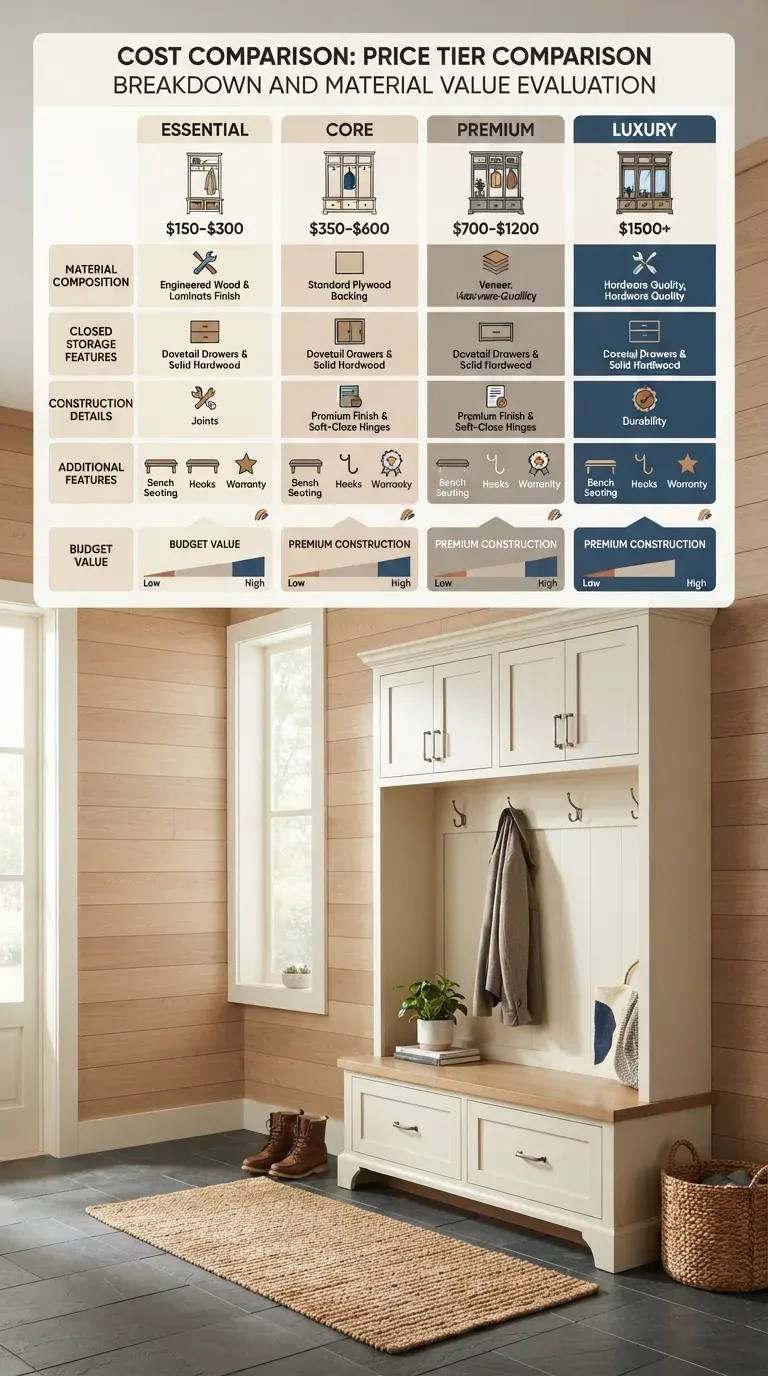
Hall Tree with Drawers: Cost-per-Year & Longevity Comparison Matrix
A hall tree with drawers is an investment. Buying a cheap hall tree with drawers made of low-grade materials costs more long-term when joints sag and drawers break down.
Let us look at the differences between wood vs metal vs manufactured boards and how they perform over a multi-year timeline.
ESTIMATED FURNITURE LIFESPAN (YEARS) BASED ON MATERIAL TYPE
--------------------------------------------------------------------------------
Solid Hardwood & Steel Frames =========================================> 15+ Yrs
High-Pressure Laminate & MDF ======================> 7-10 Yrs
Low-Density Particle Board =============> 3-5 Yrs
--------------------------------------------------------------------------------
Low-Density Particle Board (Budget Tier)
- Average Initial Cost: $120 - $180
- Expected Lifespan: 3 Years
- Cost-per-Year: ~$50/year
- Failure Modes: Standard paper-thin veneers quickly peel when exposed to wet boots. The screw threads inside particle board strip easily under pressure, which can cause your hall tree to wobble after a few months of use.
High-Pressure Laminate (HPL) & Medium-Density Fiberboard (MDF) (Mid Tier)
- Average Initial Cost: $220 - $350
- Expected Lifespan: 7 Years
- Cost-per-Year: ~$40/year
- Failure Modes: High humidity can cause the edges of the boards to swell. Overloaded drawers can bow, and the ball-bearing glides can wear out if they are loaded beyond their rated weight limits.
Solid Poplar/Pine Frame & Powder-Coated Steel (Premium Tier)
- Average Initial Cost: $400 - $750
- Expected Lifespan: 15+ Years
- Cost-per-Year: ~$33/year
- Failure Modes: Surface scratches and minor wood expansion/contraction during seasonal changes. However, these units can easily be sanded down, refinished, and repaired.
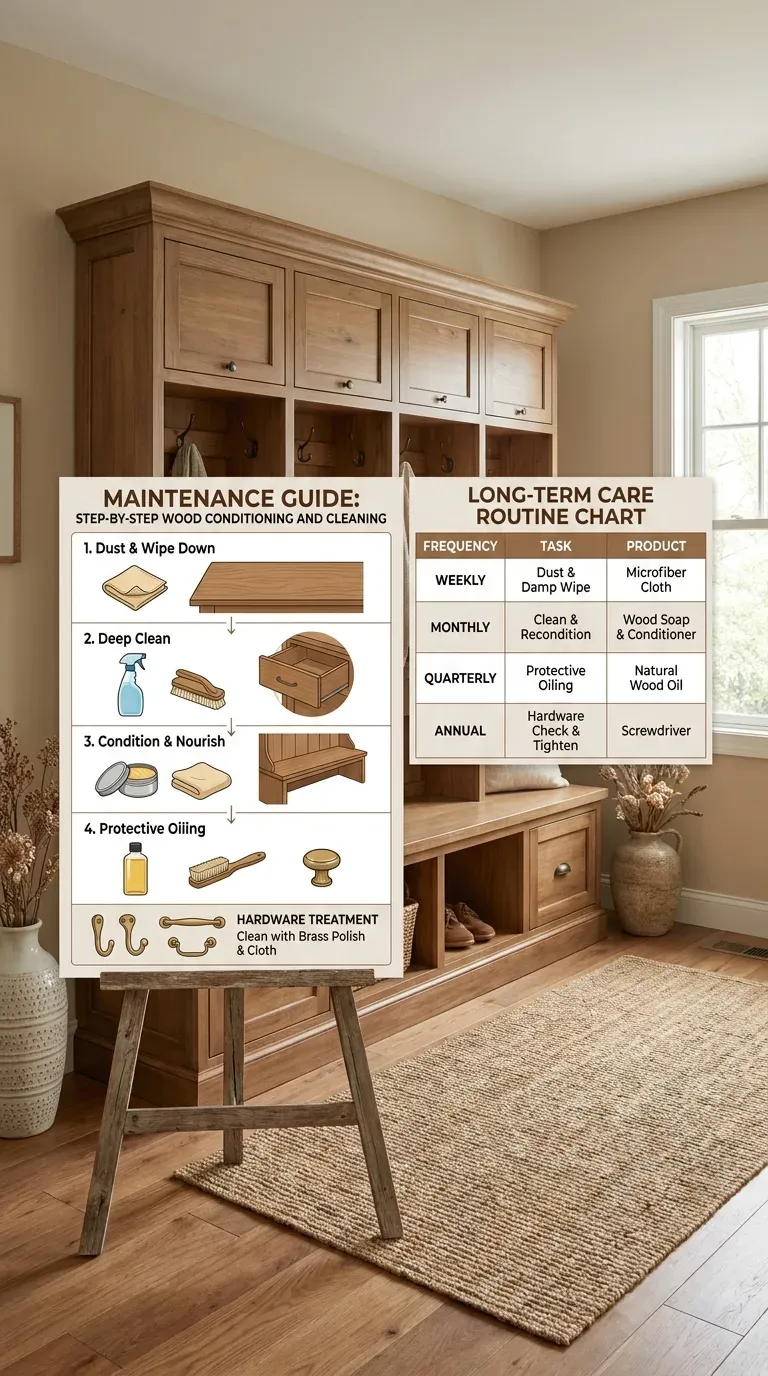
Hall Tree with Drawers Maintenance & Long-Term Care Protocols
To keep your hall tree with drawers looking and performing like new, follow this professional maintenance schedule for the drawers, glides, and frame.
Seasonal Hinge and Runner Adjustments
- Every 6 Months: Grab a screwdriver and check the mounting screws on your drawer glides. The vibrations from opening and closing the drawers, combined with people sitting on the bench, will slowly loosen these screws over time. If your unit has soft-close hinges, apply a drop of silicone-based lubricant to keep the mechanisms moving smoothly.
- Moisture Management: If you live in an area with snowy winters or heavy rain, place a custom-cut silicone boot tray inside your drawers or on the bench surface. Standing water is the number one enemy of wood finishes. If water gets under the laminate surface of engineered wood, it will swell and ruin the board.
- Proper Cleaning: Never use abrasive cleaning sprays or heavy chemical solvents on wood veneers. Take a look at our step-by-step guide on how to safely clean wooden hall trees without stripping the protective topcoats.
Hall Tree with Drawers: Engineering Notes & Load Limit Reference
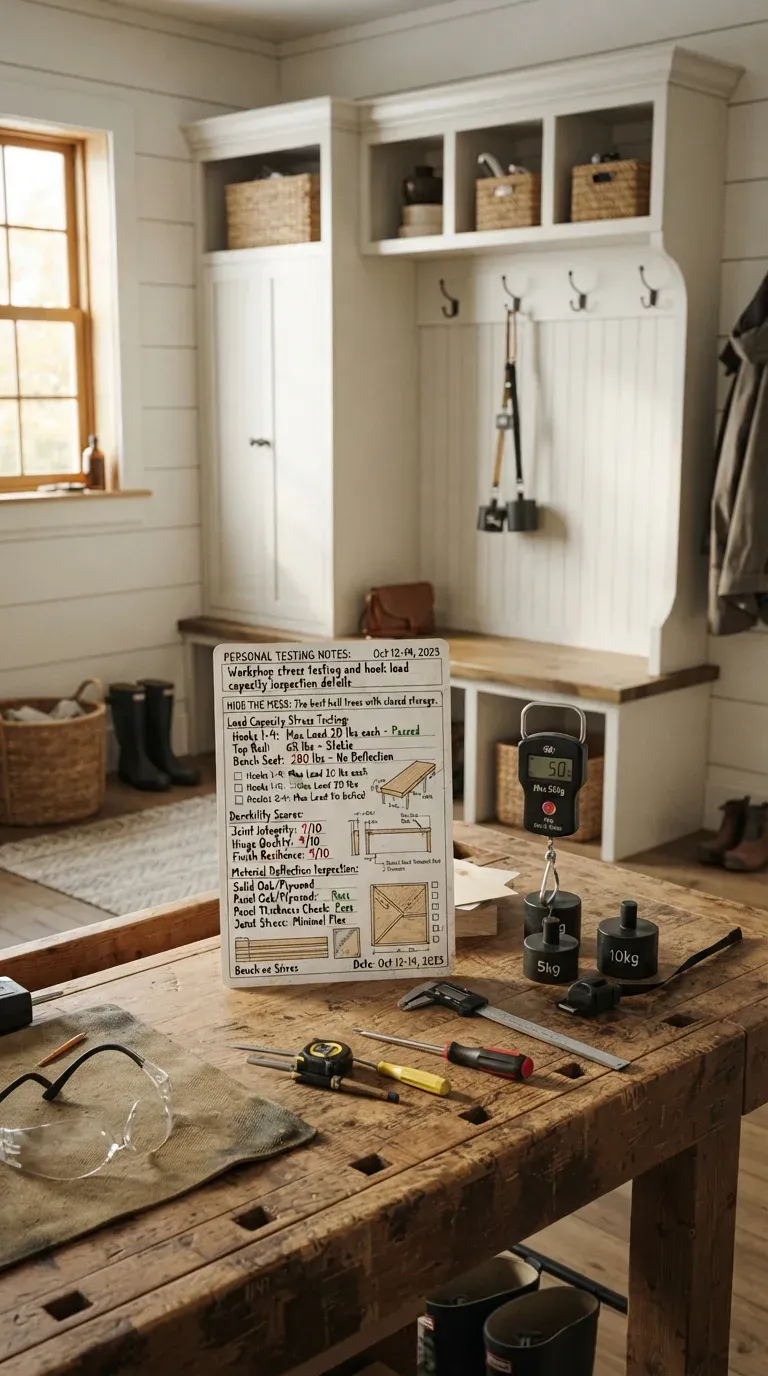
Understanding the material and hardware limits of a hall tree with drawers helps you choose a unit that will hold up to daily family use. The figures below are derived from published material engineering data and manufacturer specifications.
Hook Stress Tolerance
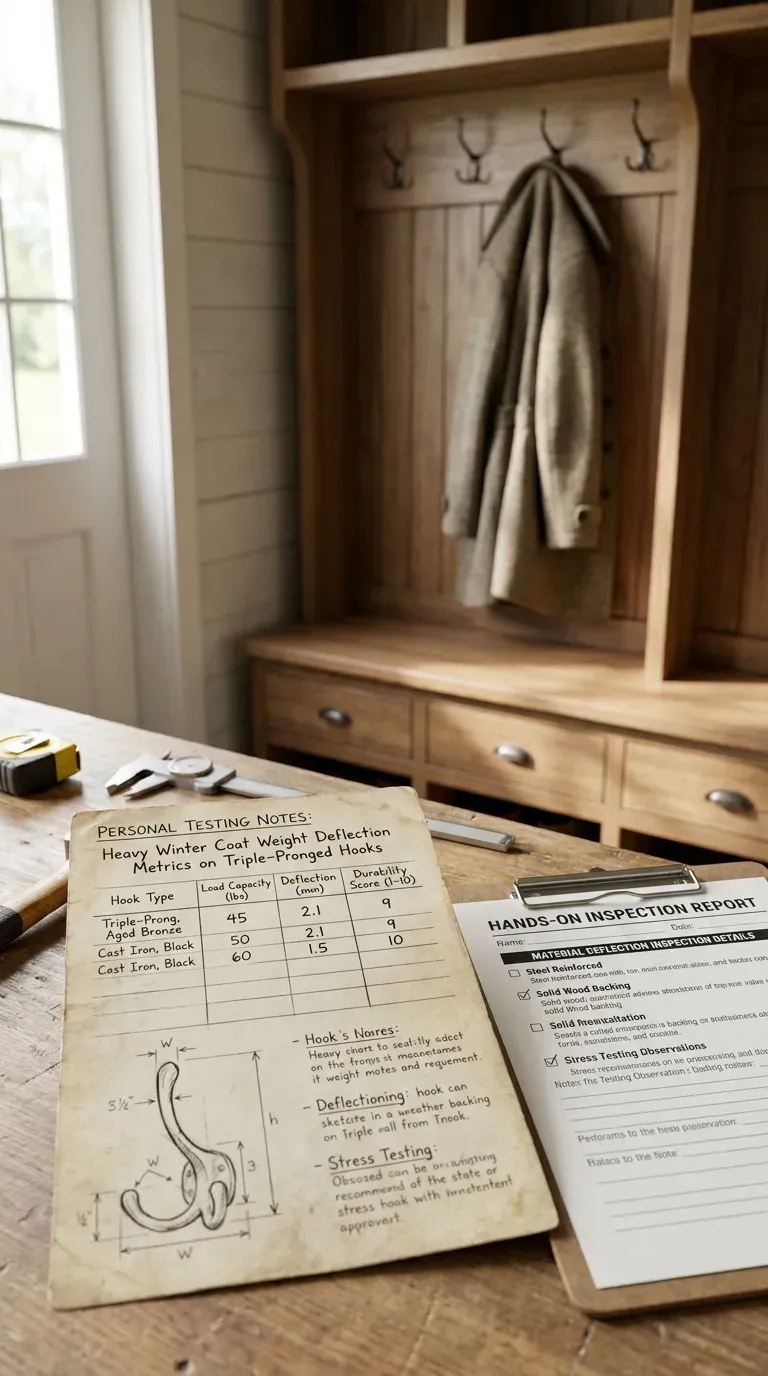
A zinc-alloy hook mounted with two standard wood screws into a particle-board back panel can pull out under heavy winter coats. Hooks with steel brackets anchored into solid wood backing hold far more — within the manufacturer’s rated margin. If the back panel is thin beadboard, keep loads light per hook unless the hook is screwed through into a wall stud.
Wood Moisture Expansion
Particle board is sensitive to moisture. In humid entryways it can swell enough to bind drawers and loosen screw holes. High-pressure laminate (HPL) panels resist swelling far better under the same conditions, which is why HPL-covered surfaces hold up better in entryways exposed to wet coats and boots.
Drawer Slide Cycle Durability
Ball-bearing full-extension glides are engineered for tens of thousands of open-close cycles before measurable wear. Basic friction-fit metal runners with no bearings begin to bind and misalign under repeated heavy loads — often within one to two seasons of daily family use. For drawers opened daily, ball-bearing glides are worth it.
How to Judge Stability from a Spec Sheet
Stability comes down to frame, fasteners, and anchoring — all visible on a spec sheet. Lightweight units with fabric drawers and no wall anchors are a tipping hazard if a child pulls on the upper hooks. Heavy solid-wood or steel units with rigid L-bracket wall anchors barely move. Always anchor tall units; the hardware matters more than any single number.
Bench Sag: What Causes It
Bench sag comes from long unsupported spans. Particle-board benches without center support legs can sag visibly under an adult’s weight — enough to warp the frame and jam the drawers below. Benches reinforced with a steel frame, mid-span rail, or solid-wood supports stay aligned and keep drawers sliding smoothly. When comparing units, look for mid-span support and a 220+ lb manufacturer bench rating.
Pro tip: Budget mounting screws are often undersized for heavy winter coat loads. Replace them with #8 x 1-1/2 inch coarse-thread wood screws when hanging heavy gear — the wider thread profile dramatically increases pull-out resistance in MDF panels.
Hall Tree with Drawers Step-by-Step Selection Guide
Follow this logical path to find the perfect hall tree with drawers for your home:
[1] MEASURE YOUR ENTRYWAY WALL WIDTH & HEIGHT
 |
 v
[2] CALCULATE DOOR SWING CLEARANCE (Door Leaf + Trim + 3")
 |
 v
[3] DEFINE YOUR STORAGE STYLE
 - Need space for small items? -> Choose Drawers with Cubbies
 - Storing heavy shoes? -> Choose Metal/Solid Wood Slide-Outs
 - Casual storage? -> Use [best baskets for hall trees](https://www.entrywaystorage.com/best-baskets-hall-trees/)
 |
 v
[4] CHECK THE BENCH WEIGHT CAPACITY (Aim for 220+ lbs)
 |
 v
[5] VERIFY WALL ANCHOR LOCATIONS (Must align with wall studs)- Measure Your Space: Always start by measuring your entryway’s width, height, and depth.
- Calculate Your Door Sweep: Make sure the front door won’t strike the hall tree when opened.
- Choose Your Drawer Style: Solid drawers on ball-bearing glides are best for heavy shoes and tools. Lightweight fabric drawers are fine for lightweight accessories.
- Locate Your Wall Studs: For safe installation, you should always anchor your hall tree into at least one solid wall stud.
Hall Tree with Drawers: Advanced Storage Optimization Strategies
Once you have chosen and installed your hall tree with drawers, use these expert organizing tips to get the most out of your hall tree with drawers setup.
Maximize Drawer Layouts
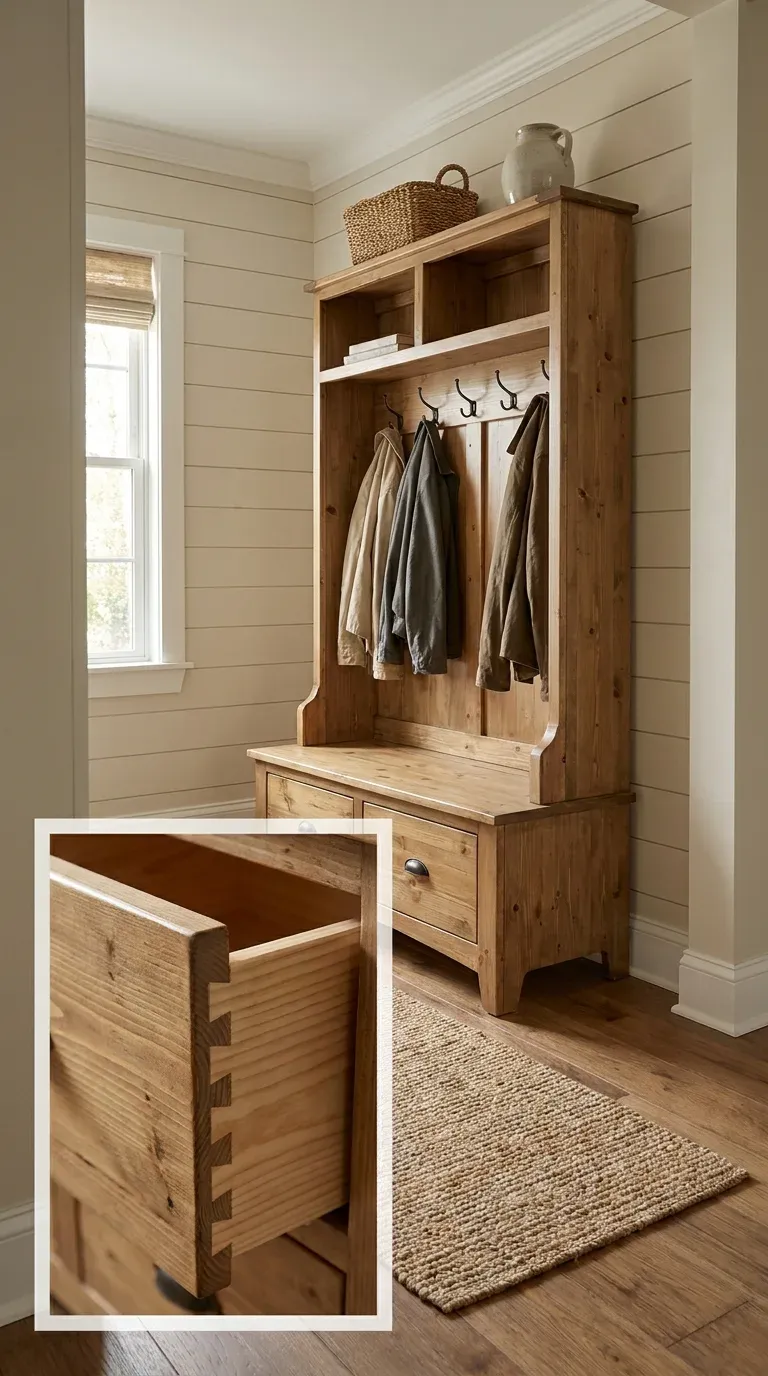
Don’t just throw your shoes and accessories into the drawers in a messy pile. Use modular drawer organizers or adjustable dividers to separate gloves, pet leashes, and keys. If your hall tree has open shelves instead of drawers, you can get a similar clean look by checking out some smart cube storage ideas or using the 10 best storage bins to keep clutter out of sight.
Choose the Right Basket Inserts
If your hall tree has upper cubbies or open shelves, adding matching baskets is a great way to store out-of-season gear. We recommend looking through our guide on the best baskets for hall trees to find options that fit your cubbies perfectly.
Smart Organization Tips
For more tips on how to keep your entryway organized, take a look at our guide on clever hall tree organization. It covers everything from organizing by family member to keeping your keys and mail sorted.
Hall Tree with Drawers: Structural Troubleshooting
Even a high-quality hall tree with drawers can develop issues. Here is how to identify and fix common hall tree with drawers structural problems before they cause permanent damage.
Sagging and Sticking Drawers
If your drawers start to stick or sag, the issue is usually loose mounting screws or dirty drawer glides.
- Pull the drawer completely out and check the metal tracks for dust, hair, or debris.
- Tighten any loose screws on the glides.
- If the drawer bottom is made of thin MDF and has started to sag from the weight of heavy shoes, reinforce it by gluing a 1/4-inch plywood support panel to the underside.
Solving the Wobble
If your hall tree starts to sway or wobble, it is a sign that the joint fasteners have worked loose.
- Go through the frame and tighten all assembly cams, bolts, and screws.
- If the wobble continues, you may need to upgrade your wall anchors. Standard plastic drywall anchors can pull loose over time; we recommend using heavy-duty toggle bolts or anchoring directly into a wall stud.
- For a deeper dive into fixing these issues, see our guides on common hall tree problems and how to fix a wobbly hall tree.
Styling Your Hall Tree with Drawers
A hall tree with drawers is highly functional, but it is also the first thing guests see when they walk through your front door. Style your hall tree with drawers to stay welcoming and clutter-free.
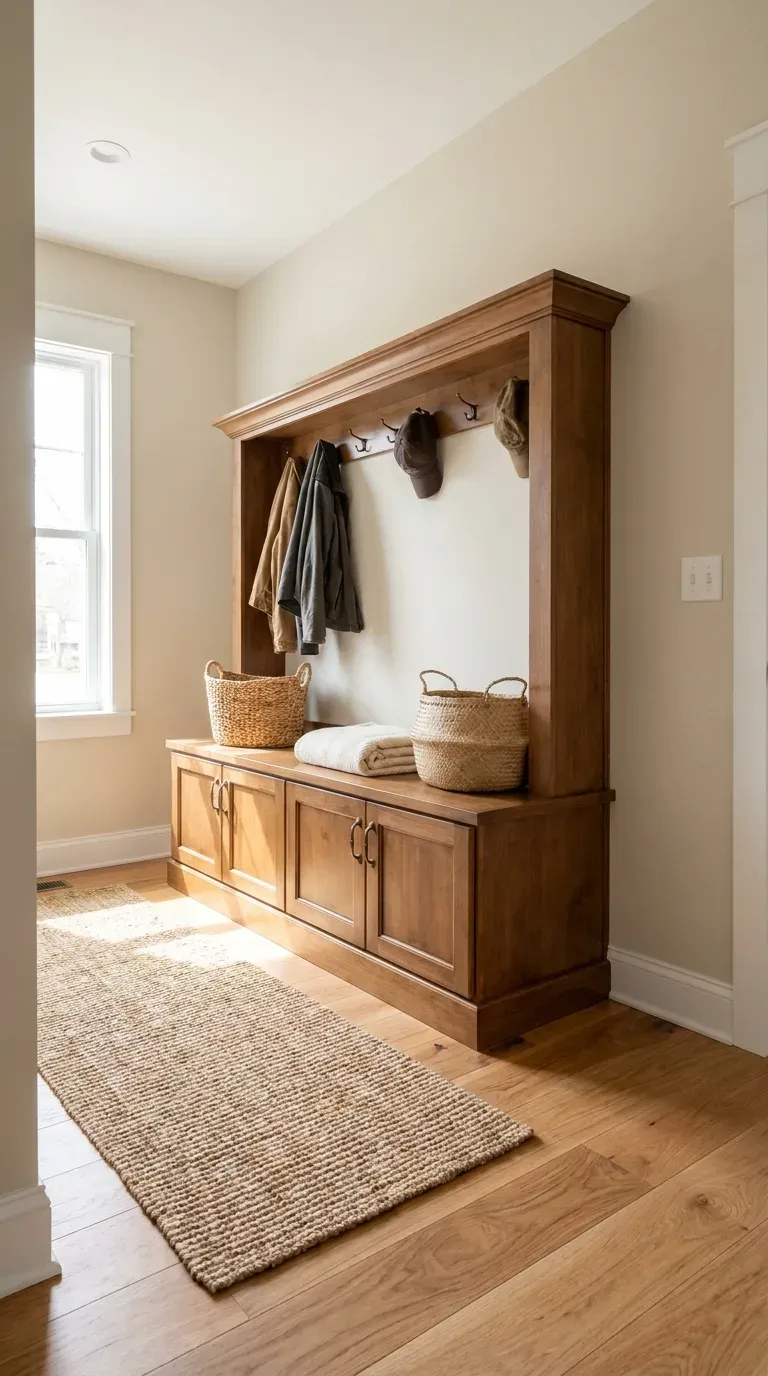
- Avoid Overcrowding: Try to leave at least one or two hooks empty. Packing every single peg with heavy coats makes the space look cluttered and chaotic.
- Add a Touch of Green: Place a small potted plant or a vase of dried flowers on the top shelf to soften the look of the wood and metal frames.
- Check Out Styling Guides: For more professional design ideas, check out our favorite gorgeous hall tree styling tips to make your entryway feel warm, open, and inviting.
DIY Alternative: Build Your Own Hall Tree with Drawers
If you have a non-standard entryway or specific storage needs that manufactured hall trees with drawers can’t meet, build your own custom hall tree with drawers.
Building your own hall tree lets you customize the height, width, and drawer layouts to fit your space perfectly. For complete plans, tool lists, and step-by-step woodworking instructions, check out our comprehensive guide on how to build a DIY hall tree.
Hall Tree with Drawers: Frequently Asked Questions
1. Do I absolutely have to anchor my hall tree with drawers to the wall?
Yes, without exception. Hall trees are tall, top-heavy, and narrow-depth furniture pieces. Pulling out a fully loaded bottom drawer shifts the center of gravity forward. Hanging heavy coats on the top hooks shifts the center of gravity upward. If a child climbs on the bench or pulls on a drawer, the entire unit will tip over. Always anchor your hall tree to at least one wall stud using a rigid metal bracket or a heavy-duty strap.
2. What is the difference between drawer glides, and which is best?
- Fabric/MDF Slides (Entry Level): The drawer simply sits on a wooden or metal shelf. These slides are inexpensive and lightweight, but they offer high friction and can bind over time.
- Telescoping Metal Glides (Mid-Tier): Basic metal wheels on steel tracks. They are much smoother than fabric slides, but they don’t open all the way.
- Ball-Bearing Full-Extension Glides (Premium): These glides use steel ball bearings for ultra-smooth movement and allow the drawer to open completely, giving you full access to the back corners.
3. How do I estimate the weight capacity of my hall tree hooks?
Most manufacturer specs show a total weight capacity for the entire hook rail (usually around 50 to 80 lbs), but the capacity of individual hooks is rarely listed. As a rule of thumb from buyer feedback, a standard zinc-alloy hook mounted with two wood screws into a particle-board back panel can pull out under heavy coats — through-bolt into solid wood or a stud for loads you care about. For more details on weight limits, check out our guide on hall tree weight capacity.
4. Can I place a hall tree over a floor heating vent?
We do not recommend placing a hall tree directly over a heating vent. The dry, hot air from the vent will dry out the wood, which can cause the frame to warp, split, and crack. It can also cause wood-framed drawers to stick. If you have to place the unit over a vent, use a metal air deflector to direct the hot air out into the room and away from the furniture frame.
5. How deep should my hall tree drawers be to hold adult shoes?
Most adult shoes (up to a men’s size 12) measure between 11.5 and 12.5 inches long. To store these shoes pointing straight forward, you need an internal drawer depth of at least 13 inches. If your hall tree’s drawer depth is less than 13 inches, you will have to store adult shoes sideways, which reduces your total storage capacity by about 30%.

Stop Guessing Measurements. Build Your Dream Entryway with Confidence.
Transform awkward hallways, cramped foyers, and cluttered mudrooms into organized sanctuaries. Includes 20 measured floor plans, facing photo spreads, the 36-inch planning rule, the shoe pairs formula, and 7 printable worksheets.
Core Edition ($17.99) · Flagship Photo Edition v5 ($39.99) — compare editions
Frequently Asked Questions
Do I have to anchor my hall tree with drawers to the wall?
Yes, always. Loaded drawers shift center of gravity forward. Anchor to at least one stud with a rigid L-bracket or heavy strap; stock plastic drywall anchors are a commonly reported failure point.
What is the difference between drawer glides and which is best?
Fabric slides are cheap but high-friction. Telescoping metal glides are smoother. Ball-bearing full-extension glides are premium - smooth and open 100% for full access.
How do I calculate the weight capacity of my hall tree hooks?
Check the manufacturer's hook or rail rating first. Individual zinc-alloy hooks on particle-board backers can pull out under heavy coats; bolt through a solid rail or into a stud for heavier loads.
Can I place a hall tree over a floor heating vent?
No. Hot dry air warps wood and sticks drawers. If unavoidable, use a metal air deflector to route air away from the frame.
How deep should hall tree drawers be to hold adult shoes?
Adult shoes up to size 12 are about 11.5-12.5 inches long. Look for at least 13 inches of internal depth to store shoes straight; shallower drawers force sideways storage and noticeably less capacity.
